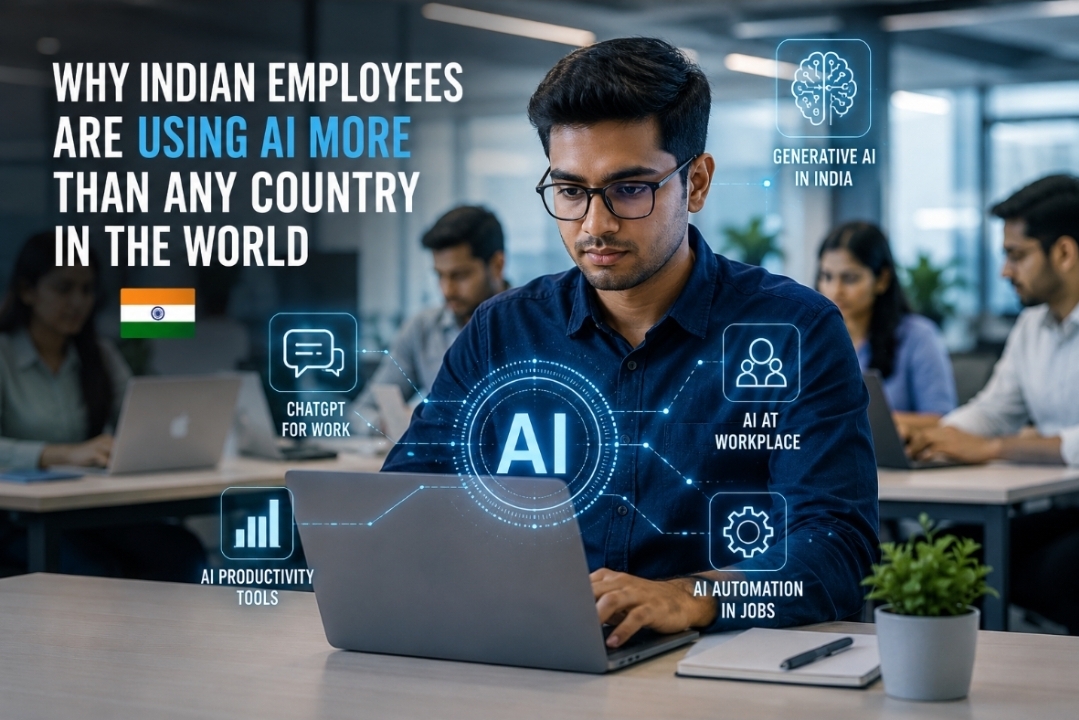
Artificial Intelligence is no longer a futuristic idea in India. It has become a part of daily office life. From writing emails and preparing presentations to analyzing customer data and automating repetitive tasks, AI at workplace environments is changing the way Indian employees work faster than ever before.
Over the last two years, India has emerged as one of the world’s fastest-growing users of Artificial Intelligence technologies. Whether it is a startup founder in Bengaluru, a bank employee in Patna, a software engineer in Hyderabad, or a content creator working from home, millions of Indian professionals are now depending on AI productivity tools to save time and improve efficiency.
But one important question is being asked everywhere:
Why are Indian employees using AI more aggressively than workers in many developed countries?
The answer is not simple. It is connected to India’s work culture, competition, economic pressure, digital growth, and the desire to move ahead quickly in career and business. Today, generative AI in India is not just a trend—it is becoming a workplace revolution.
This article explores the real reasons behind the rapid AI adoption in India, the impact of AI automation in jobs, and the future of AI jobs in India in a deeply human and practical way.
India’s Work Culture Is Driving Faster AI Adoption
India has one of the most competitive work cultures in the world. Employees often work long hours, handle multiple responsibilities, and face constant pressure to deliver faster results.
Unlike many Western countries where work-life balance is prioritized, Indian employees are usually expected to manage heavy workloads with limited resources. Because of this, AI tools for employees have become more than just technology—they have become survival tools.
For example:
Marketing teams use AI to create content quickly
Bank employees use AI for reporting and customer communication
HR departments use AI to screen resumes
Students and freelancers use ChatGPT for work and research
Developers use AI coding assistants to write software faster
In simple words, AI is helping Indian professionals do more work in less time.
That is one of the biggest reasons why Indian employees using AI has become such a major trend.
The Rise of Generative AI in India
The launch of tools like ChatGPT, Gemini, Claude, and Microsoft Copilot completely changed how people think about productivity.
Earlier, AI was mostly limited to large tech companies. But now, generative AI in India is available to almost everyone with a smartphone or laptop.
A small business owner can now:
Write marketing emails using AI
Create product descriptions instantly
Generate invoices automatically
Translate content into multiple languages
Analyze customer feedback within minutes
This accessibility has made AI popular among both corporate professionals and ordinary workers.
India’s young population also plays a huge role here. The country has millions of digitally active users who quickly adopt new technologies. Unlike older generations that sometimes hesitate to trust automation, younger Indian employees are experimenting with AI every day.
For many people, using AI is not seen as cheating—it is seen as smart working.
Why Indian Employees Feel Comfortable Using AI
One of the strongest reasons behind AI adoption in India is adaptability.
Indian workers have always adapted quickly to technological changes:
Internet revolution
Smartphone revolution
Digital payments
UPI ecosystem
Remote work culture
Online education
AI is simply the next step.
Employees in India are used to learning new systems quickly because job competition is intense. If one employee becomes more productive using AI productivity tools, others feel pressure to learn the same skills.
This creates a chain reaction inside offices and industries.
For example:
One employee uses ChatGPT for work reports
Another uses AI for Excel analysis
Another uses AI presentation tools
Soon, the entire team depends on AI-based workflows
As a result, workplace AI trends 2026 are expected to grow even faster across India.
ChatGPT for Work Has Changed Daily Office Life
Perhaps no AI tool has influenced workplaces more than ChatGPT.
Today, ChatGPT for work is common in:
Banking
Customer support
Education
Marketing
Software development
Content writing
Sales communication
Employees use it to:
Draft professional emails
Create meeting summaries
Write reports
Generate social media captions
Solve coding problems
Improve grammar
Brainstorm business ideas
In many offices, employees quietly use AI even when companies have not officially approved it yet.
This shows something important:
AI is becoming a personal productivity assistant for workers.
Earlier, employees spent hours on repetitive tasks. Now, many of those tasks can be completed within minutes using AI tools for employees.
This saves time, reduces stress, and increases output.
Economic Pressure Is Pushing People Toward AI
India’s middle-class workforce faces enormous financial pressure today.
Rising costs of: Rent, Education, Fuel, Healthcare, Loans, Daily living expenses
have created intense career pressure.
Employees want:
Faster promotions
Better salaries
Side income opportunities
Higher productivity
Better job security
AI helps people achieve these goals faster.
A content writer can now complete more articles daily. A graphic designer can create ideas quickly. A programmer can debug code faster. A sales executive can automate customer responses.
This is why AI at workplace environments is growing rapidly—not just because AI is innovative, but because people feel they cannot afford to fall behind.
AI Automation in Jobs: Opportunity or Threat?
While AI offers huge benefits, many employees are also worried about job security.
There is growing fear regarding AI automation in jobs, especially in sectors involving repetitive tasks.
Some employees fear:
Data entry jobs may disappear
Customer support roles may reduce
Basic content writing may become automated
Administrative work may shrink
These fears are not completely wrong.
However, experts believe AI will not simply replace workers—it will transform jobs.
For example:
Accountants may shift toward financial strategy
Writers may focus more on creativity
HR professionals may focus more on people management
Customer support teams may handle complex issues instead of repetitive questions
The real risk is not AI itself.
The real risk is refusing to learn AI skills.
Employees who understand AI productivity tools are likely to stay more relevant in the future workforce.
India’s Startup Ecosystem Is Accelerating AI Usage
India is currently one of the world’s largest startup ecosystems.
Thousands of startups are using AI for:
Automation
Marketing
Analytics
Hiring
Customer service
Product development
Unlike traditional companies, startups move very fast. They prefer employees who can work smarter using AI tools for employees.
This startup culture influences even larger companies.
As startups become more efficient using AI, traditional businesses also feel pressure to modernize their operations.
This competition is pushing AI adoption in India to new levels.
Remote Work Made AI Even More Important
The work-from-home revolution changed employee behavior permanently.
Remote workers often manage:
Meetings
Reports
Communication
Scheduling
Documentation
without physical support from teams.
AI became a digital assistant during this transition.
Today, employees use:
AI meeting summaries
AI scheduling assistants
AI writing tools
AI transcription software
AI customer support systems
This has increased dependency on workplace AI trends 2026 technologies across industries.
Even small businesses are now experimenting with automation because they want to reduce costs and improve productivity.
Indian Companies Are Encouraging AI Learning
Earlier, employees learned AI secretly.
Now, companies themselves are encouraging AI training.
Many organizations have started:
AI workshops
Internal AI courses
ChatGPT training sessions
AI productivity programs
This shift shows that businesses no longer see AI as optional.
They see it as necessary.
Large companies understand that employees using AI can:
Work faster
Reduce errors
Improve communication
Increase efficiency
Save operational costs
This is why Indian employees using AI is no longer just a personal trend—it is becoming a corporate strategy.
The Human Side of AI Usage
Despite all the technology, the story of AI in India is deeply human.
Behind every AI user is a person trying to:
Save time
Reduce stress
Earn more
Protect their career
Compete in a fast-changing world
A young employee in a small town may use ChatGPT for work interviews. A freelancer may use AI to manage multiple clients. A teacher may use AI to prepare lessons. A banker may use AI for faster reporting.
People are not using AI because they are lazy.
They are using AI because modern work pressure has become extremely intense.
This human reality is one of the biggest reasons why generative AI in India is growing so rapidly.
The Future of AI Jobs in India
The future of AI jobs in India looks both exciting and challenging.
Many new job roles are already emerging:
AI trainers
Prompt engineers
AI content specialists
AI consultants
Automation managers
AI ethics experts
At the same time, traditional jobs will continue evolving.
Future employees may not compete against AI.
Instead, they may compete against people who know how to use AI better.
This means learning AI is becoming as important as learning computers was two decades ago.
Schools, colleges, and companies are now slowly recognizing this shift.
In the coming years, AI skills may become mandatory for many careers.
Workplace AI Trends 2026: What to Expect Next
Experts believe workplace AI trends 2026 will focus heavily on:
Personalized AI assistants
AI-generated reports
Automated meetings
Smart analytics
AI hiring systems
AI customer service
AI-based training
India is expected to remain one of the fastest-growing AI markets globally because of:
Large workforce
Young digital population
Startup growth
Increasing internet access
Strong demand for productivity
Even regional language AI tools are improving rapidly, making AI accessible to non-English users as well.
This could dramatically increase AI adoption in India in smaller cities and rural areas.
Will AI Replace Human Intelligence?
One important question remains:
Can AI truly replace humans?
The answer is more complicated than many people think.
AI can:
Generate text
Analyze data
Automate tasks
Improve efficiency
But humans still provide:
Emotions
Creativity
Leadership
Trust
Human connection
Ethical judgment
A machine can write an email. But it cannot fully understand human emotions behind difficult conversations.
A machine can generate content. But real storytelling still comes from human experiences.
This means the future workplace may belong to employees who combine:
Human intelligence
Emotional understanding
AI productivity tools
together effectively.
Conclusion
India’s rapid AI growth is not happening by accident.
It is the result of:
Intense work culture
Economic pressure
Digital awareness
Career competition
Startup innovation
Adaptability of Indian workers
Today, AI at workplace environments is becoming normal across industries.
From large corporations to small businesses, from metro cities to smaller towns, Indian employees using AI are transforming how work gets done.
At the same time, AI automation in jobs is creating both excitement and anxiety.
The future will likely reward workers who learn how to work alongside AI instead of fearing it.
One thing is clear:
The future of AI jobs in India has already started.
And India may become one of the world’s most important examples of how humans and Artificial Intelligence can work together to reshape the modern workplace.