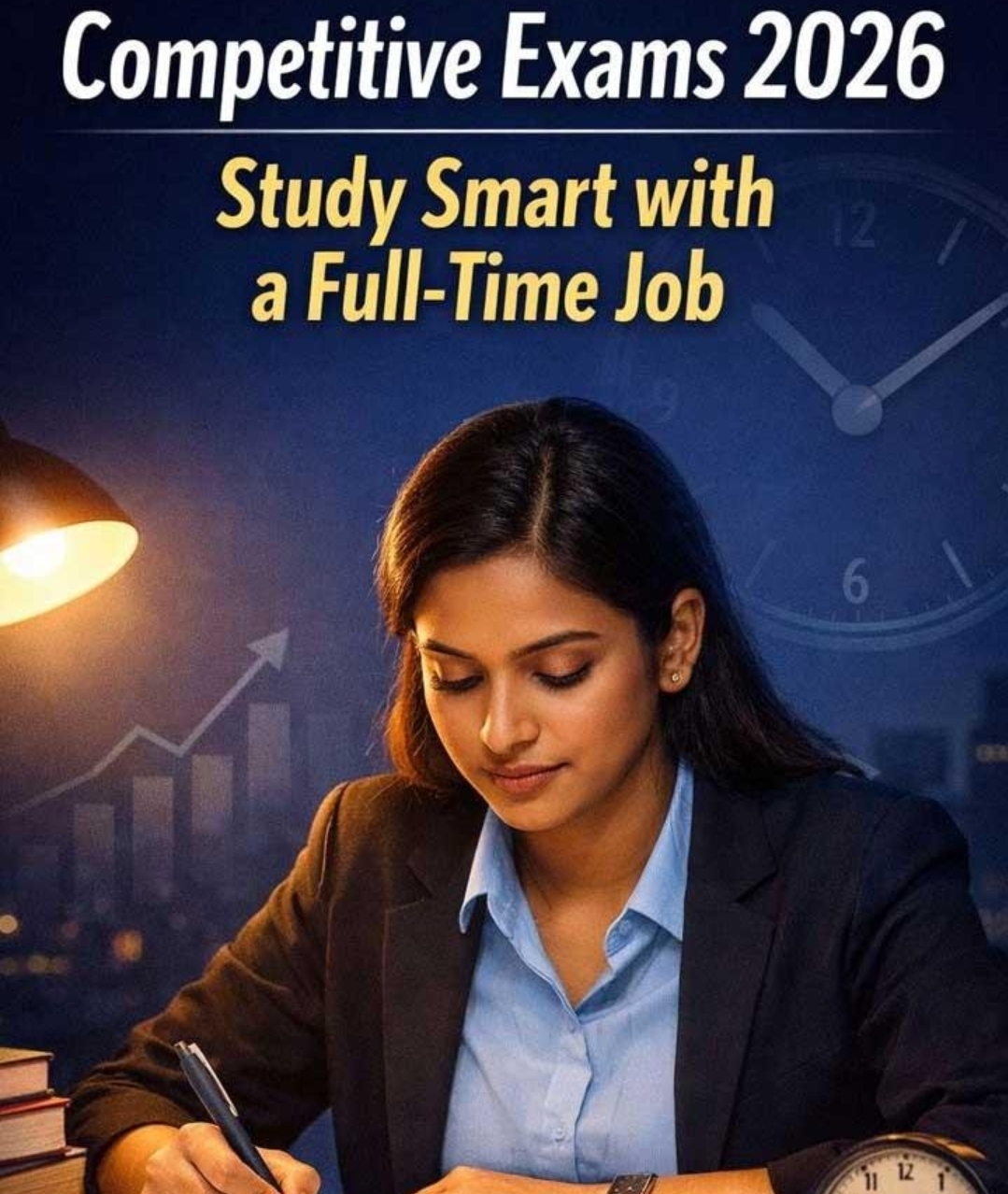
In India, thousands of working professionals dream of securing a stable banking job through competitive exams like SBI PO, IBPS PO, SBI Clerk, RBI Assistant, and IBPS Clerk. However, balancing a demanding job and exam preparation often feels overwhelming. Long office hours, mental exhaustion, family responsibilities, and lack of time make preparation difficult for many aspirants.
Still, every year, many candidates successfully crack bank exams while working full-time. The secret is not studying for 12 hours daily. The real secret lies in smart planning, consistency, discipline, and proper strategy.
If you are struggling to manage your office job along with preparation, this detailed guide will help you understand exactly how to prepare efficiently without burning out. This article covers the best study methods, time management strategies, daily routines, and practical tips that actually work for working professionals.
Why Bank Exams Are Difficult for Working Professionals
Preparing for bank exams while doing a full-time job is challenging because your energy and time are already divided. Most working employees leave home early and return late in the evening. After office work, very little energy remains for studying.
Some common problems faced by aspirants include:
Lack of study hours
Stress from office workload
Difficulty maintaining consistency
Weekend laziness
Social distractions
Mobile phone addiction
Mental fatigue after work
Despite these challenges, working professionals often perform better than full-time students because they usually have stronger discipline, maturity, and practical decision-making skills.
The key is to use limited time effectively.
How to Crack Bank Exams While Working Full Time
The biggest myth among aspirants is that cracking banking exams requires studying all day. In reality, quality matters more than quantity.
If you are wondering how to crack bank exams while working full time, the answer is simple:
Follow a realistic routine
Study consistently every day
Focus on weak areas
Avoid unnecessary pressure
Revise regularly
Practice mock tests
You do not need perfection. You need consistency.
Even 3–4 focused hours daily can produce excellent results if used properly.
Understand the Bank Exam Pattern First
Before preparation, understand the exam structure clearly.
Most banking exams include:
Preliminary Exam
English Language
Quantitative Aptitude
Reasoning Ability
Main Examination
Advanced Quant
Reasoning & Computer Aptitude
General Awareness
English
Descriptive Writing
Interview (for PO-level exams)
Understanding the syllabus helps you avoid wasting time on irrelevant topics.
Bank Exam Preparation Tips for Working Professionals
Many working candidates fail not because they are weak academically, but because they lack planning. Here are practical and proven bank exam preparation tips for working professionals.
1. Create a Realistic Timetable
Do not copy the study schedule of full-time aspirants.
Instead, create a timetable according to your office routine.
Example Schedule
Time Activity
6:00 AM – 7:30 AM Quant or Reasoning
Office Hours Current Affairs Revision
8:30 PM – 10:30 PM English + Mock Practice
Weekends Full Mock Tests
A realistic schedule works better than an unrealistic one.
2. Study Daily Without Breaks
Consistency matters more than motivation.
Even on busy days:
Read current affairs for 20 minutes
Solve 10 aptitude questions
Revise formulas
Small efforts every day create massive improvement over time.
3. Focus on High-Scoring Topics
Working professionals should prioritize scoring topics first.
Important Quant Topics
Simplification
Approximation
DI
Percentage
Profit & Loss
Important Reasoning Topics
Seating Arrangement
Puzzle
Syllogism
Coding-Decoding
Important English Topics
Reading Comprehension
Cloze Test
Error Detection
Smart selection saves time.
SBI PO Preparation Strategy for Working Employees
SBI PO is one of the toughest banking exams in India. Competition is extremely high, especially among working candidates.
An effective SBI PO preparation strategy for working employees should focus on smart preparation instead of long study hours.
Phase 1: Build Basics
Spend the first 2 months strengthening:
Arithmetic concepts
Grammar rules
Logical reasoning basics
Without strong basics, mock tests become frustrating.
Phase 2: Increase Speed
Speed is extremely important in SBI PO.
Practice:
Timed quizzes
Sectional tests
Daily calculations
Mental calculation speed can improve significantly within 60 days.
Phase 3: Mock Test Practice
Mock tests are game changers.
Attempt:
2 mocks weekly initially
4–5 mocks weekly near exams
Always analyze mistakes after every mock.
IBPS PO Preparation With Job
Many aspirants search for the best approach for IBPS PO preparation with job because IBPS exams attract lakhs of candidates every year.
The best strategy is:
Morning = Concept Learning
Use morning hours for difficult subjects.
Evening = Practice
After office:
Solve quizzes
Attempt sectional tests
Revise formulas
Weekends = Full-Length Mock Tests
Weekends should be treated like exam simulation days.
Daily Study Plan for Bank Exams
A proper daily study plan for bank exams helps working professionals stay disciplined.
Monday to Friday Plan
Morning: Quantitative Aptitude, Practice calculations
Lunch Break: Current Affairs, Banking Awareness
Night: English or Reasoning
Saturday Plan: Full mock test, Weak topic analysis
Sunday Plan: Revision, Vocabulary, Formula practice, Puzzle solving
This balance prevents burnout.
Bank Exam Time Management Tips
Time management is the biggest weapon for working aspirants.
These bank exam time management tips can dramatically improve performance.
1. Use Dead Time Smartly
During: Travel, Lunch break, Waiting time
You can: Revise vocabulary, Read current affairs, Watch concept videos
2. Avoid Mobile Distractions
Social media destroys focus.
Limit: Instagram, YouTube Shorts, Random scrolling
Even saving 1 hour daily can change your results.
3. Study According to Energy Levels
Do difficult subjects when your brain is fresh.
Usually: Morning = Quant
Night = English or revision
4. Avoid Multitasking
Focus on one topic at a time.
Studying multiple subjects simultaneously reduces retention.
Best Books for Bank Exam Preparation
Choosing the best books for bank exam preparation is important because too many resources create confusion.
Quantitative Aptitude
RS Aggarwal, Arun Sharma, Quantum CAT, Reasoning, MK Pandey
Analytical Reasoning by RS Aggarwal
English, SP Bakshi, Word Power Made Easy
Current Affairs, Monthly PDFs
Banking awareness capsules
Avoid collecting too many books.
Master limited resources.
Bank Exam Preparation at Home
Many aspirants believe coaching is compulsory. That is not true.
Successful bank exam preparation at home is possible if you maintain discipline.
Advantages of Home Preparation
Saves money
Flexible schedule
Comfortable environment
Personalized strategy
Requirements
Internet connection
Mock test platform
Consistency
Self-discipline
Home preparation works if you stay serious.
How to Prepare for Bank Exams Without Coaching
Thousands of candidates crack banking exams every year without joining coaching institutes.
If you want to know how to prepare for bank exams without coaching, follow these steps:
1. Use Free Online Resources
YouTube channels, PDFs, and mock platforms are enough for preparation.
2. Follow One Strategy Only
Do not change study plans every week.
Stick to one roadmap for at least 3 months.
3. Practice Daily
Practice matters more than theory.
Bank exams are speed-based exams.
4. Analyze Mistakes
Most candidates repeat mistakes because they never analyze them.
Maintain an error notebook.
How Many Hours to Study for Bank Exams
One of the most common questions is how many hours to study for bank exams while working.
The answer depends on your: Basics, Speed, Learning ability, Office schedule
However, generally:
Beginners
4–5 hours daily
Average Candidates
3–4 hours daily
Advanced Candidates
2–3 focused hours
Quality study matters more than sitting with books all day.
Importance of Mock Tests
Mock tests are non-negotiable.
Without mocks:
Speed remains slow
Accuracy suffers
Time management becomes weak
Benefits of mock tests:
Real exam experience
Confidence improvement
Stress reduction
Better accuracy
Always analyze:
Wrong answers
Time spent
Weak sections
Common Mistakes Working Professionals Make
Avoid these mistakes:
1. Studying Randomly
Without strategy, hard work gets wasted.
2. Ignoring Revision
Revision is essential for retention.
3. Comparing With Others
Everyone’s schedule is different.
4. Taking Too Much Stress
Stress reduces productivity.
5. Skipping Mock Tests
Mocks are essential for success.
Motivation Tips for Working Aspirants
Preparation becomes mentally exhausting after office work.
To stay motivated:
Remember your goal daily
Avoid negative people
Track small progress
Celebrate small achievements
Most successful candidates are ordinary people with extraordinary consistency.
How Long Does It Take to Crack Bank Exams?
It depends on your current level.
Average Timeline
Beginners: 8–12 months
Moderate Level: 5–6 months
Experienced Aspirants: 3–4 months
Consistency can reduce preparation time significantly.
Final 60-Day Strategy Before Exam
In the last 2 months: Focus On, Mock tests, Revision, Current affairs, Speed improvement, Avoid, New books, New strategies, Unnecessary stress
Confidence matters greatly during the final stage.
Can Working Professionals Really Crack Bank Exams?
Absolutely yes.
In fact, many toppers are working employees because they:
Value time better
Stay disciplined
Work with maturity
Handle pressure efficiently
A full-time job is not your weakness. Poor planning is.
Conclusion
Cracking banking exams while managing a full-time job is difficult, but definitely achievable. The journey requires patience, consistency, and intelligent preparation rather than endless study hours.
If you truly want success, stop waiting for perfect conditions. Start using the time you already have. Even 3 focused hours daily can transform your future.
Remember:
Consistency beats intensity
Mock tests are essential
Smart study matters more than long study hours
Discipline creates results
Whether you are preparing for SBI PO, IBPS PO, Clerk, or RBI exams, the right strategy can help you achieve your dream banking job while continuing your current employment.
Stay focused, stay patient, and trust the process. Your effort today can completely change your career tomorrow.
FAQ (Q&A)
Q1. Can I crack bank exams while doing a full-time job?
Yes, many working professionals successfully crack SBI PO, IBPS PO, and Clerk exams by following a smart study plan and maintaining consistency.
Q2. How many hours should a working professional study for bank exams?
A working candidate should study at least 3–4 focused hours daily along with longer study sessions on weekends.
Q3. Which is the best time to study for bank exams while working?
Morning hours are best for difficult subjects like Quant and Reasoning, while evenings are suitable for revision and mock tests.
Q4. Is coaching necessary for bank exam preparation?
No, coaching is not compulsory. Many aspirants crack bank exams through self-study, online mock tests, and free study resources.
Q5. What is the best SBI PO preparation strategy for working employees?
The best strategy includes daily practice, sectional mock tests, current affairs preparation, and consistent revision with proper time management.
Q6. How can I manage office work and bank exam preparation together?
Create a realistic timetable, avoid social media distractions, use travel time for revision, and study consistently every day.
Q7. Which books are best for bank exam preparation?
Popular books include RS Aggarwal for Quant, MK Pandey for Reasoning, and SP Bakshi for English preparation.
Q8. Are mock tests important for banking exams?
Yes, mock tests improve speed, accuracy, confidence, and time management skills, which are essential for clearing banking exams.
Q9. Can I prepare for bank exams at home?
Yes, bank exam preparation at home is possible with proper discipline, online resources, and a regular study routine.
Q10. How long does it take to crack SBI PO or IBPS PO exams?
Most candidates take around 6–12 months depending on their basics, consistency, and preparation strategy.